Välj din region
Välj den region som bäst passar din plats eller dina preferenser.

International

Sverige

Norge

Danmark

Suomi

United Kingdom

Deutschland

France

België

Nederland

Österreich

Schweiz

Italia

España
Välj ditt webbplatsspråk
Denna inställning styr språket för användargränssnittet, inklusive knappar, menyer och all text på webbplatsen. Välj ditt föredragna språk för bästa surfupplevelse.
Engelska
English
Svenska
Svenska
Norska
Norsk
Danska
Dansk
Finska
Suomi
Tyska
Deutsch
Franska
Français
Nederländska
Nederlands
Italienska
Italiano
Spanska
Español
Välj språk för jobbannonser
Välj de språk för jobbannonser du vill se. Denna inställning avgör vilka jobbannonser som visas för dig.
 ourg and working on various aspects of mitochondrial research, encompassing different models (yeast, plants, human) and different approaches (structural, biophysical, biochemical, functional and biomedical) and the associate partner, PolyPlus Transfection. Mitochondria are essential intracellular organelles of eukaryotic cells responsible for a large number of processes: respiration, ATP-generation, synthesis of some amino acids, oxidation of fatty acids, regulation of reactive oxygen species, apoptosis, etc. Mitochondria are implicated in the aging process, in many severe and mostly incurable neuromuscular and neurodegenerative syndromes, as well as in diseases such as Alzheimer's disease or some cases of cancer and diabetes. The peculiarity of these organelles protected by a double membrane is the presence of their own mitochondrial genome in their inner compartment, mtDNA. mtDNA differs in organization and size among species and codes for only few organellar macromolecules. Since most of the macromolecules are nuclear-encoded, mitochondrial biogenesis and activities, in health as well as in disease depend on a continuous cross-talk with the nucleo-cytosolic compartment of the cell. In depth understanding of
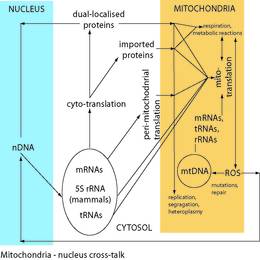 these interaction and coordination mechanisms and characterization of the involved mitochondrial molecular machines are therefore of primary importance from both fundamental and medico-social points of view. The overall objective of the MitoCross network is to deepen the knowledge of the fine molecular mechanisms governing mitochondrial biogenesis, genetics and cross-talk with the nucleus, to characterize as many actors as possible in different organisms and to subsequently exploit this knowledge to understand the biochemical mechanisms underlying mitochondrial diseases, to envision agronomic applications and model innovative therapy approaches.